
Analysis of Electronic Excitations#
Electron donor-acceptor (EDA) complexes are photoactive complexes that have UV/VIS absorption bands that are not present in the donor and acceptor molecules separately. This indicates an excitation that corresponds to the transfer of an electron from the electron donor to the acceptor. EDA complexes can be used, among other things, to photogenerate radicals without the use of toxic metals. The electron transfer band is often red-shifted, so the use of low energy UV or even visible light is often possible.
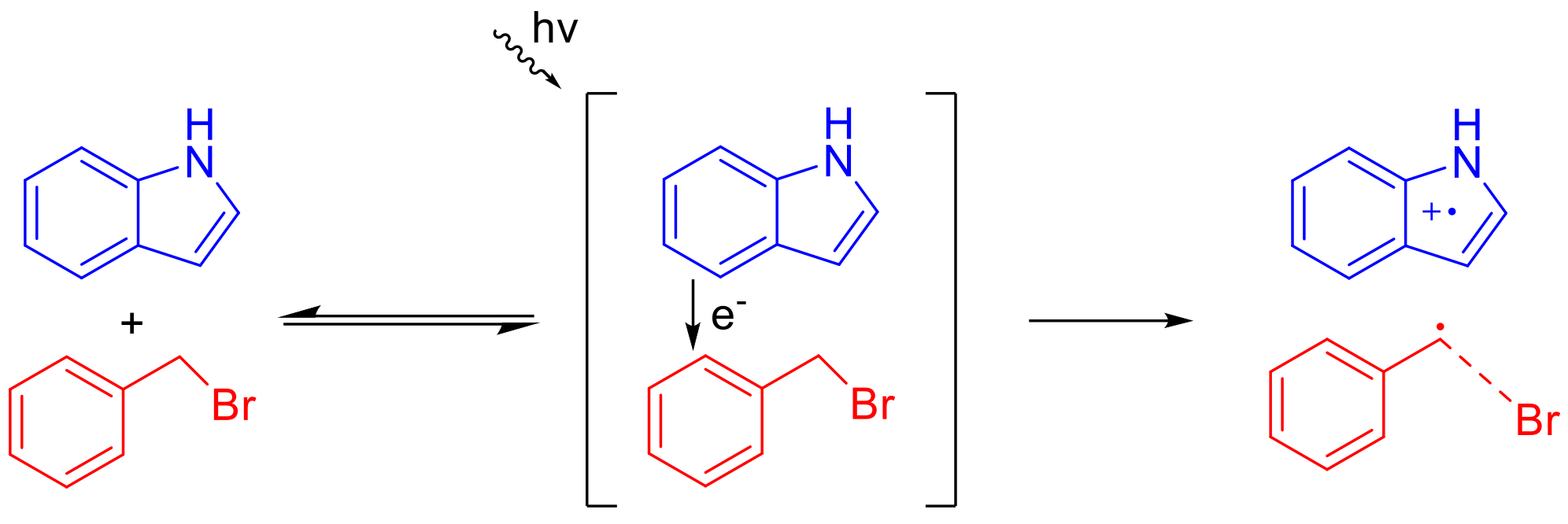
Generation of two free radicals by the photon-mediated electron transfer in the indole-benzylbromide electron donor complex.#
While the AMSSpectra program provides a nice graphical user interface to view electronic excitations calculated using ADF, there is sometimes a need to programmatically access the data from these calculations. In this example we will load and analyse excitations from an ADF calculation on the indole-benzylbromide complex using the TCutility package. We will also implement some tunable thresholds to filter the excitations the program reads. r
Download excitations.adf.rkf
Download exc_analysis.py
'''
This example shows how to analyse and filter excitation data from an ADF calculation.

The example system used is an electron donor-acceptor complex formed from indole and benzylbromide.
We are looking for transitions that have a wavelength higher than 300 nm, oscillator strength of
at least 1e-4 a.u.
The transitions corresponding to the excitations should have contributions higher than 10%
and the donating orbital for the transition should have at least 90% Donor fragment character
and the accepting orbital should have at least 90% Acceptor fragment character.
'''

import tcutility.results2
import pyorbb

# exc should have wl of at least 300
wavelength_thresh          = 300
# and oscillator strength of at least 1e-4
oscillator_strength_thresh = 1e-4
# the contribution of a transition to an exc should be at least 10%
contribution_thresh        = 0.1
# the donor character of the donating MO should be at least 90%
donor_thresh               = 0.9
# and the acceptor character of the accepting MO should be at least 90%
acceptor_thresh            = 0.9

# we need to load the calculation with tcutility to read the excitation data
# it will be stored in the ``properties.excitations`` attribute.
res = tcutility.results2.read('excitations.adf.rkf')
# also load the orbital objects
orbs = pyorbb.Orbitals('excitations.adf.rkf')

# the excitation data is sorted by the irrep (only 'A' for this system)
# and the excitation type (only 'SS' = singlet-singlet for this system)
excitation_data = res['properties']['excitations']
for irrep, irrep_data in excitation_data.items():
    for excitation_type, data  in irrep_data.items():
        for exc_index in range(data['number_of_excitations']):
            wl = data['wavelengths'][exc_index]
            # set a threshold for the wavelength
            if wl < wavelength_thresh:
                continue

            f12 = data['oscillator_strengths'][exc_index]
            # and for oscillator strength
            if f12 < oscillator_strength_thresh:
                continue

            # obtain the contributions and MO names
            contribs = data['contributions'][exc_index]
            from_MO_names = data['from_MO'][exc_index]
            to_MO_names = data['to_MO'][exc_index]

            n_transitions = len(contribs)
            transitions = []
            # each excitation has N transitions that contribute to it
            for transition_index in range(n_transitions):
                contrib = contribs[transition_index]
                # the contribution should be higher than 0.1
                if contrib < contribution_thresh:
                    continue

                # obtain the donating MO
                from_MO_name = from_MO_names[transition_index]
                from_MO = orbs.mos[from_MO_name]
                # the donor character should be high
                if from_MO.fragment_character('Donor') < donor_thresh:
                    continue

                # and the accepting MO
                to_MO_name = to_MO_names[transition_index]
                to_MO = orbs.mos[to_MO_name]
                # the acceptor character should be high
                if to_MO.fragment_character('Acceptor') < acceptor_thresh:
                    continue

                # if the transition survives we will write a string for it later
                transitions.append(f'{from_MO} ({from_MO.fragment_character("Donor"):.1%} Donor) -> {to_MO} ({to_MO.fragment_character("Acceptor"):.1%} Acceptor)')

            # write the data associated with this excitation
            print(f'Excitation[{irrep}, {excitation_type}, {exc_index+1}]:')
            print(f'  λ   = {wl:.1f} nm')
            print(f'  f12 = {f12:.4f} a.u.')
            print('  Transitions:')
            [print('    ' + transition) for transition in transitions]
            print()
The expected output is as follows
Excitation[A, SS, 2]:
  λ   = 384.9 nm
  f12 = 0.0006 a.u.
  Transitions:
    73A_B (99.2% Donor) -> 74A_B (99.2% Acceptor)
    73A_A (99.2% Donor) -> 74A_A (99.2% Acceptor)

Excitation[A, SS, 5]:
  λ   = 340.1 nm
  f12 = 0.0172 a.u.
  Transitions:
    72A_B (93.5% Donor) -> 74A_B (99.2% Acceptor)
    72A_A (93.5% Donor) -> 74A_A (99.2% Acceptor)

Excitation[A, SS, 9]:
  λ   = 308.2 nm
  f12 = 0.0003 a.u.
  Transitions:
    73A_A (99.2% Donor) -> 76A_A (98.7% Acceptor)
    73A_B (99.2% Donor) -> 76A_B (98.7% Acceptor)